

The dream is clear: a better life, a stable job, maybe a Master’s degree from a top-tier university in Canada, the UK, or the US. We call it “Japa”—the great escape. But while you’re busy dreaming of winter coats and stable electricity, there’s a whole industry of “agents” dreaming of your life savings.
Let’s be real: Nigerian migrants are some of the most resilient people on earth, but even the smartest of us can fall for a well-packaged lie. In 2026, the scams have gone high-tech. From AI-generated “government officials” to fake LinkedIn recruiters, the traps are everywhere.
If you want to move, move legally. Here is everything you need to know to keep your money in your pocket and your dreams on track.
1. The “Too Good to Be True” Job Offer

We’ve all seen them in our WhatsApp groups or Facebook feeds: “Urgent! 50 Cleaners needed in Dubai. Salary: $4,000/month. No experience needed. Free flight. Just pay ₦2 Million for processing.”
The Reality Check: No legitimate company in Europe or North America is going to hire a random person from a WhatsApp flyer without a single Zoom interview. If the salary is five times what the job usually pays and they are “hurrying” you to pay before the slot fills up, run.
Real-Life Situation: Take the story of “Chidi” (name changed). He paid an agent ₦3.5 million for a “guaranteed” construction job in Canada. The agent gave him a beautiful, stamped offer letter. When Chidi arrived at Pearson Airport in Toronto, the border officer looked at the letter and laughed—the company on the letterhead didn’t even exist. Chidi was deported on the next flight.
2. The “I Have a Connection Inside” Lie

Nigerian scammers love the “Man Know Man” card. They’ll tell you they have a cousin working at the VFS Global office or a friend in the US Embassy who can “pull files” to the top.
The Reality Check: Embassies are highly automated and strictly audited. No “inside man” can bypass a digital fingerprint scan or a background check. If someone asks for money to “fast-track” your visa through a back door, they are simply taking your money and praying you get the visa naturally so they can claim credit. If you get rejected, they’ll say “the system changed.”
3. The Fake “Scholarship” Trap
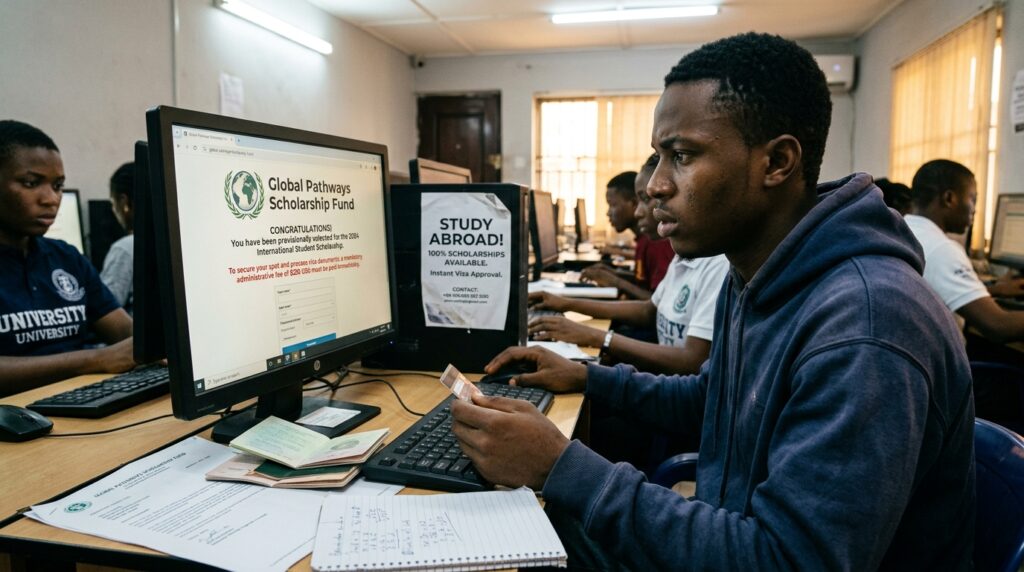
For our students, this is the most common bait. You get an email saying you’ve won a “Commonwealth-Standard Scholarship” you never applied for. All you need to do is pay a “registration fee” of $250.
The Reality Check: Real scholarships give you money; they don’t ask for it. If you have to pay to “claim” a prize, it’s not a prize—it’s a purchase, and usually a fake one.
Red Flags: The “Scammer’s Starter Pack”
If you see these four things, close your laptop and walk away:
- Payment via Cryptocurrency or Gift Cards: No embassy or legitimate university accepts iTunes cards or Bitcoin.
- Urgency: “If you don’t pay by 4 PM today, the portal will close forever!” This is a psychological trick to stop you from thinking clearly.
- Generic Emails: Does the “Official UK Home Office” email end in @gmail.com or @yahoo.com? If yes, it’s a scam. Official government emails end in .gov.ng, .gov.uk, or .gc.ca.
- No Contract: If an agent refuses to give you a signed service agreement or a receipt with a verifiable office address, they are planning their disappearance.
How to Protect Yourself (The Pro Checklist)
- Verify the Agent: In 2026, many countries have public registries. For Canada, check the College of Immigration and Citizenship Consultants (CICC) website. If your agent isn’t on there, they aren’t authorized.
- Do Your Own Research: Use the official government websites (e.g., Canada.ca or gov.uk). Everything you need to know is usually there for free.
- The “Photo” Test: Scammers often use stock photos for their “successful visa” testimonials. Right-click the image and select “Search image with Google.” If that “successful student” is also appearing on a dentist’s website in Brazil, you’ve found your answer.
- Ask for the Application ID: If an agent says they’ve submitted your form, ask for the official login details or the application tracking number. If they refuse, it’s because they haven’t submitted anything.
Final Thoughts
Japa is a marathon, not a sprint. The ₦5 million you want to “shortcut” the process could be the same ₦5 million that starts your life comfortably once you arrive legally. Don’t let desperation blind you.
The best way to avoid an immigration scam is to be your own best advocate. Read, verify, and stay sharp.
Have you ever encountered a suspicious travel agent? Share your experience in the comments below—let’s keep the community safe!